
Use it right now
Find the safest essential actions in seconds.
Free Starter Kit + practical 30-day practice plan
Get an immediate action guide, then use its seven short practice steps over the next 30 days with one recurring difficult moment: what to say, what happens next, how to continue when your child remains upset, and how to repair when you lose patience.
Especially useful for difficult moments with children ages 2–6. The complete kit is available immediately, and its seven practice steps can be used at your own pace.
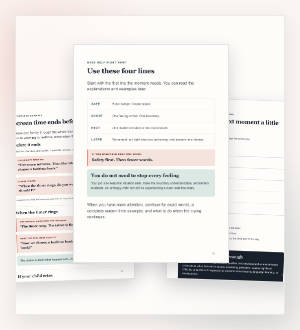
A reference for now. A practice plan for later.
SAFE–SHORT–NEXT–LATER gives you four decisions while everyone is overwhelmed. The guided series helps you apply each decision to one moment that already happens in your family—and shows what to adjust when the first attempt does not bring calm.
Find the safest essential actions in seconds.
Prepare what to say and what happens next.
Finish with a response that fits your family’s routine.
Seven guided steps · about three minutes each
The guide gives you the complete method. Each short practice step helps you apply one part to a moment that already happens in your family—without adding a course, an app, or a long homework list.
STEP 01
Start with one pattern that keeps taking over.
STEP 02
Decide the real next activity before everyone is upset.
STEP 03
Choose one feeling or fact and one clear boundary.
STEP 04
Know what to do when crying or refusal continues.
STEP 05
Plan for rejected choices, time pressure, and unsafe behavior.
STEP 06
Return after a sharp response without abandoning the boundary.
STEP 07
Notice realistic progress, adjust one part, and keep the response that fits your family.
Clear beginning. Clear ending. Seven practical steps to use at your own pace over 30 days.
Get my free Starter KitA complete example
The guide stays with you from the five-minute warning through bedtime. It does not pretend one sentence should make an upset child immediately happy.
Before it ends
“Five more minutes. Then the tablet goes away and we choose a bedtime book.”
When the timer rings
“The timer rang. The tablet is finished.”
If your child keeps crying
“You can be upset. The tablet is staying off. I’m here with you.”
If brushing teeth cannot wait
“It is time to brush teeth. Do you want to walk or should I carry you?”
If your child cannot choose, the guide shows you how to continue without inventing more choices.
Start with immediate access, then use seven short guided steps to choose your words, continue after refusal, and keep a personal plan.
Get my free Starter KitProgress without a perfect outcome
The guide and practice series help you recognize progress without pretending difficult feelings should disappear. They also show how to return to safety and put right your part if you speak too sharply.
Why trust the guidance?
Momentures compared guidance and research relevant to clear directions, safe boundaries, emotionally responsive parenting, parental self-regulation, and screen-time transitions. The guide keeps limitations visible instead of presenting its scripts as magic formulas.
Start with the guide now. At your own pace over the next 30 days, turn one recurring difficult moment into a personal plan you can remember under pressure.
Get my free Starter KitSeven short practice steps. About three minutes each. Work through them at your own pace.
